New Presbyterian Reformed Church plant in Jasper, Indiana

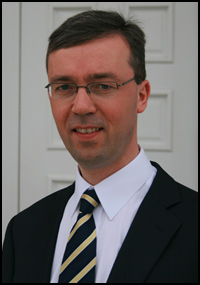
Rev. Brad Freeman

We are a new fellowship of families growing in Reformed doctrines, worshiping according to Scripture, and looking forward to the Lord’s blessing upon us.

The Presbyterian Reformed Church is an indigenous North American group of churches continuing historic Scottish Presbyterian orthodoxy in doctrine, worship, government and discipline, on the basis of a conviction that these principles and practices are founded upon and agreeable to the Word of God.

We confess the Scriptures of the Old and New Testaments to be the Word of God written, the only infallible rule of faith and life.

We declare the Westminster Confession of Faith and Catechisms to be founded upon and agreeable to the Word of God in setting forth the system of truth taught in Holy Scripture.

We affirm our adherence to and determination to continue the simplicity and purity of worship hitherto practiced in these congregations.

We accept the Westminster Directory for the Public Worship of God as a scriptural and suitable guide for the conduct of public worship.

We adopt the Presbyterian form of church government as the form of government instituted by Christ for the government of His church to the end of the age.

Presbyterian Reformed Church
303 Main Street
Jasper, IN  47546
Bradford C. Freeman, Minister

“We hold, whether rightly or wrongly, that to undertake to praise God with songs other than those which the Holy Spirit has inspired for that purpose is a sin, and such a sin as, unrepented of, should prevent a person from sitting down at the Lord’s table, either in our Church or in any other.”

W. J. McKnight makes the point below that people who are guilty of the sin of singing uninspired hymns in worship should not be allowed to the Lord’s Table. This is certainly a controversial opinion, any thoughts?
“IMPARTIALITY IN APPLICATION

Furthermore, as Christ Jesus is no respecter of persons, we ought not to be, either; for, to be a Christian, if it means anything, means to be like Christ. This, that passage from James, already quoted, settles in so many words. And this our Church has always recognized. When one of our own members violates this commandment in the way referred to, he lays himself open to discipline. A faithful Session will prohibit him from coming to the Lord’s table until he has confessed his sin, given evidence of repentance, and promised not to be guilty of it again. If, then. the Church prevents its own members from communing if they commit this sin, why should it not prevent outsiders from communing when they commit the same sin? Why should the Session practice “respect of persons”? It is the violation of the law of God that is in question, and surely it is as bad for one man to transgress a divine command as it is for another. Believing this we apply “the law of the house”, as Ezekiel calls it, to prospective communicants, no matter who they may be. In reality we go below the question of the Church to which a person belongs to the question as to whether or not he is obeying the Ten Commandments.

ADDITIONAL INTERPRETATIONS

The same line of reasoning lies at the basis of our position on Psalmody, and on Instrumental Music in divine worship, and on Secret Societies. And here again we are at one, fundamentally, with the whole Presbyterian body. We all accept the Westminster Standards. These declare that the Second Commandment forbids “all devising, counselling, commanding, using, and any wise approving, any religious worship not instituted by God Himself”, and anything and everything that would tend toward the corrupting of “the worship of God, adding to it, or taking from it”, whether such devices are “invented and taken up of ourselves, or received by tradition from others, though under the title of antiquity, custom, devotion, good intent, or any other pretense whatsoever”. As for the Third Commandment, they declare that it forbids “the not using God’s name as is required; and the abuse of it in an ignorant, vain, irreverent, profane, superstitious, or wicked mentioning or otherwise using His titles, attributes, ordinances, or works”. It would be difficult to make language stronger or more explicit.

Now our Church holds that this interpretation of those Commandments binds the people of God to the exclusive use of the Psalms in divine worship, and puts them under solemn obligation to sing praises, as in apostolical times, without the use of musical instruments, and requires them to renounce the system of secretism as a system of darkness altogether unworthy of such as are called of God to be “the light of the world”.

Thus it is our interpretation of the first three Commandments—reinforced, of course, from the rest of the Bible—that gives us our distinctive position as a Church. If our interpretation is not right, we ought to disband. If it is right, our Sessions ought to see that it is honored in every particular by every person who proposes to come to the Lord’s table under their jurisdiction. The “whole limit” is to be “most holy”. To the officers has been committed the charge, by the Lord Jesus Himself, of keeping it so. If they are faithful, they will do it—and that, too, as the Word of God requires, “without respect of persons” This is one place where sentiment has no right to intrude; obedience to orders is what the occasion demands, and the demand is absolute.

All denominations have to reckon with the Ten Commandments. All alike have to assume some attitude toward the Moral Law. Some treat the matter very loosely and unsatisfactorily; some are more rigid, some are less. We, in common with all others are under the necessity of taking a stand. We have done it. We have interpreted the Law, and what constitutes its violation, to the very best of our ability. We have published our findings. The world knows our position. We pledge ourselves to be true to those findings and to that position every time we go to the communion table. We aim to be strictly impartial. We are no firmer with outsiders than we are with our own members. “Here is the law of the house”, we say; “Christ requires us to see that the law is observed; we have no option but to obey orders”.

BY WAY OF SUMMARIZING

What our findings are—I mean those findings which keep us distinct from other Churches—may be fairly, yet succinctly, set forth in four brief statements.

We hold, whether rightly or wrongly,—yet as a matter of fact we do hold,—that to support an unchristian Constitution in its unchristian condition is a sin, and such a sin as, unrepented of, should prevent a person from sitting down at the Lord’s table, either in our Church or in any other.

We hold, whether rightly or wrongly, that to undertake to praise God with songs other than those which the Holy Spirit has inspired for that purpose is a sin, and such a sin as, unrepented of, should prevent a person from sitting down at the Lord’s table, either in our Church or in any other.

We hold, whether rightly or wrongly, that to introduce instrumental music into the New Testament worship, when the Apostles organized that worship without it, is a sin, and such a sin as, unrepented of, should prevent a person from sitting down at the Lord’s table, either in our Church or in any other.

We hold, whether rightly or wrongly, that union with secret societies is a sin, and such a sin as, unrepented of, should prevent a person from sitting down at the Lord’s table, either in our Church or in any other.

The fact is that we find ourselves under obligation, in these respects, to bear a faithful testimony not only to the world, but to such other Churches also as differ with us on these intrinsically important questions. At the communion table our testimony comes to its climax. Shall we weaken where we should be firmest? Shall we waver where we should be immoveable? Shall we make it apparent on the Holy Mount that we are sincere in our conclusions and mean to maintain them to the end, or shall we choose the Holy Mount to make it apparent to other Churches and to the world, that we only half believe what we profess? Here, of all places, it would seem, we ought to aim to be perfect, even as our Father which is in heaven is perfect (Matt. 5:48).

Evidently this is not the place to defend our position as a Church, as it comes to light in our distinctive principles. All we needed to do here was to state the principles fully enough to bring the situation clearly into mind. And this, we assume, has been done.

A CASE IN POINT

An incident that happened a few years ago in my ministry might be cited in this connection, it seems to me, as an apt illustration. One of the ablest men I ever knew—the pastor of a neighboring congregation—accosted me on the street one day and said, “One thing about your Church I could never understand, that is, your position on Close Communion”. In reply I said, “In point of principle our views on that question are the same as yours”. “How is that?” he said. “Suppose”, said I, “that one of your members should strike a child down with an ax and kill it, would your Session allow him to go to the Lord’s table at the next communion?” “Well”, said he, “I should hope not”. “Why?” I asked. “Why, because he violated the Sixth Commandment”, he said. “But”, I protested, “he might hold that what he did was not murder”. “Oh”, said my friend, “we would not leave that to him; we would take that matter into our own hands”. “You mean to say”, I said, “that your Session would assume the responsibility of interpreting the Sixth Commandment and also of passing judgment on the man’s conduct, as to whether it was a violation of the Commandment thus interpreted”. “Precisely”, he said. “Well, then,” said I, “why should you object to our Sessions when they do the same thing with respect to the First Commandment, and the Second, and the Third? “Oh, I see”, he said, “and what is more I believe you are right; it never occurred to me in that light; with you Close Communion means that the Reformed Presbyterian Church intends to honor the Moral Law as the Church apprehends it, before anyone shall be permitted to take a seat at the Lord’s table under its jurisdiction and oversight”. “Yes”, said I, “that is the exact situation as we see it”; and the man was satisfied. After all, to any person who really stops to consider, it is only a question of clear thinking and a sincere purpose to follow orders.”

From CONCERNING CLOSE COMMUNION. AN INVESTIGATION. by W.J. MCKNIGHT, D.D., Pastor of the First Reformed Presbyterian Church of Boston found here Concerning Close Communion by WJ Mcnight.

“There is no light in Old or New Testament to warrant any other; either you must fancy a Psalm, and say Christ meant this way, when he spake of the Book of the Psalms, and devise a new way of worship out of your own brains, or else sing the Psalms which Christ and His Apostles call Psalms.”

1622-1654

“Let us consider the vanity of the contrary opinion [distinguishing between Psalms, hymns and spiritual songs], in regard it utterly makes way for will worship, which they seem to be so much against. For first, I am commanded to sing Psalms, Hymns, Songs; The Old and New Testaments speak of no other Psalms than of David and Asaph and of such like inspired persons; and they are called by Christ and his Apostles, but you must not sing them (say they). I ask what Psalms then must you sing? There is no light in Old or new Testament to warrant any other; either you must fancy a Psalm, and say Christ meant this way, when he spake of the Book of the Psalms, and devise a new way of worship out of your own brains, or else sing the Psalms which Christ and His Apostles call Psalms. Besides, how can any man persuade himself, or others, when he sings, that he sings a Psalm, when he doth not sing that which Scripture has only called a Psalm? Or how can any man distinguish, now I sing a Psalm, now a Hymn, now a Song, where there is not one word in the New Testament to distinguish them from one another, or the two latter from the Book of Psalms? If any man from the New Testament can distinguish a Psalm from a Hymn, or a Hymn from an Ode or a Song, or any one from another, but as they borrow it from the Old Testament, he shall be an Oracle.”

by Cuthbert Sidenham, from A Christian, sober and plain exercitation on the two grand practical controversies of these times : infant baptism and singing of psalms (1654), page 188-189 found here

At his execution, John Nisbet of Hardhill “sang the first six verses of the 34th psalm, and read the eighth chapter of the Romans, and prayed with great presence of mind, and very loud. He then went up the ladder, rejoicing and praising the Lord.”

JOHN NISBET OF HARDHILL (1627-1685)

“John Nisbet was born about the year 1627. He was the son of James Nisbet, and was lineally descended from Murdoch Nisbet of Hardhill, who, about the year 1500, joined those called the Lollards of Kyle; when a persecution being raised against them, he fled over seas, and took a copy of the New Testament, in writing, along with him. Some time after, he returned home, and digged a vault in the bottom of his own house, to which he retired, serving God, reading his new book, and instructing such as had access to him out of it.

John Nisbet being somewhat advanced in years, and having the advantage of a tall, strong, well built body, and of a bold, daring, manly spirit, went abroad and joined the military. Having spent some time in foreign countries he returned to Scotland, and swore the covenants at the same time that King Charles, upon his coronation, swore them at Scone, viz. 1650. Then, having left the military, he came home and married Margaret Law, one who proved a true and kind yoke-fellow to him all the days of her life, and by whom he had several children, three of whom survived himself…”

At the time of his execution…

“He sang the first six verses of the 34th psalm, and read the eighth chapter of the Romans, and prayed with great presence of mind, and very loud. He then went up the ladder, rejoicing and praising the Lord. And so, upon the 4th of December, 1685, in the 58th year of his age, ended that race, which he had run with faith and patience.”

Psalm 34:1-6 from the 1650 Scottish Psalter:

1 God will I bless all times; his praise my mouth shall still express.
2 My soul shall boast in God: the meek shall hear with joyfulness.
3 Extol the Lord with me, let us exalt his name together.
4 I sought the Lord, he heard, and did me from all fears deliver.
5 They look’d to him, and lighten’d were: not shamed were their faces.
6 This poor man cry’d, God heard, and sav’d him from all his distresses.

From Lives of the Scottish Covenanters by John Howie, p465 ff, found here

John Nisbet the younger “had a grave courage and staidness when he came to the place of execution; he prayed, and sang Psalm 16:5, to the close, with a great deal of affection and joy.”

“In 1683, Major White was fully empowered to fine and imprison all those who refused to acknowledge the Episcopal rule, or were supposed to sympathise with the Covenanters. It was in this year the Council granted him Justiciary power upon his apprehending John Nisbet the younger, as he was styled, to distinguish him from John Nisbet of Hardhill to prosecute him on the spot on the charge of being at Bothwell Bridge. He was accordingly tried at Kilmarnock, and sentenced to be hanged at the Cross. The spot where the gallows stood at the south comer is still marked by a circle of small white stones, and the initials of his name, J. N. Wodrow says “he had a grave courage and staidness when he came to the place of execution ; he prayed, and sang Psalm 16:5, to the close, with a great deal of affection and joy.”

Psalm 16:5 from the 1650 Scottish Psalter:

God is of mine inheritance and cup the portion;
The lot that fallen is to me thou dost maintain alone.

Nisbet belonged to the parish of Loudon. His execution was the only one which took place at Kilmarnock. His remains were buried in the Low Church burying-ground; an upright stone marks his grave, on which is carved a pistol, cross swords, and flags, and on a sculptured scroll the words,

Solemn League and Covenant, God and our Country, and underneath is inscribed :

HERE LIES
JOHN NISBET
who was Taken by-
Major Balfour’s Party &
Suffered at Kilmarnock
4th April 1683 for adhering
To the Word of GOD and our
Covenants. Rev. xii. & 1 1
Renewed by Public
Contribution
A.D. 1823.

On the other side:

Come, Reader, see, here pleasant NISBET lies :
Whose Blood doth pierce the high and lofty Skies.
Kilmarnock did his latter Hour perceive ;
And Christ his Soul to Heaven did receive.
Yet bloody Torrans did his Body raise
And bury’d it into another place :
Saying, Shall Rebels ly in Grave with me?
We’ll bury him where Evil-doers be.

Near the grave of Nisbet is a martyr-stone of remembrance to John Ross and John Shields, who suffered at Edinburgh, and had their heads set up at Kilmarnock.

From Inscriptions on the Tombstones and Monuments Erected in Memory of the Covenanters [microform] with historical introd. and notes (1881), p 134-135 found here

Pilgrim Covenant Church of Singapore

The following article on Pilgrim Covenant Church of Singapore appeared recently in The Straits Times newspaper:

“The church sings psalms from a 1650 Scottish hymn book in a room without adornment. There are no instruments.

Pastor J. J. Lim, 46, exhorts the congregation of 150 at Pilgrim Covenant Church, perched on stackable plastic chairs, to obey God rather than bend to modern society’s norms and noise.

In 1999, the former software engineer founded the church, which desires to live right by being rooted in Biblical truths. ‘We are taught how to worship in the fear of God rather than merely for carnal enjoyment,’ he says.

‘We are taught how to respect and obey our civil authorities. We are taught to do good works and how to deal with disappointments in life. We are taught how husbands and wives ought to relate to one another.’

Such an emphasis on upright living flows from searching the Bible and the Reformed statements of beliefs, mainly the Westminster Confession of Faith. This is regarded as an accurate summary of the Bible covering all aspects of church, society and family life. ‘It teaches us who God is, and what duty God requires of man. It points us to the Holy and Sovereign God, and to Jesus Christ our Saviour,’ Pastor Lim explains.

Reformed churches are a spectrum of Protestant denominations established in 16th-century Europe. They were part of the Reformation, a radical time when reformers like Martin Luther and John Calvin opposed the doctrines and corruption of the Roman Catholic Church.

Theologian Simon Chan of the Trinity Theological College notes: ‘Reformed churches are a mixed bag ranging from purists like the Bible Presbyterians to the majority of Presbyterians in Singapore who are quite indistinguishable from other ‘mainstream’ Christians.’

Some Reformed churches want to return to the ideal of John Calvin’s 16th-century Geneva, where he was influential as a church reformer. ‘It presupposes that that period was the unsurpassed high point of the Reformation.’

Core Reformed beliefs include the sovereignty of God, and that salvation depends on God’s grace and not man’s merit or effort.

At Pilgrim Covenant Church, roots and anchors are important. Says its deacon, Dr. Fong Chee Wai, a biomedical scientist in his early 40s: ‘We live in a world that is changing constantly – our physical, social, economic and cultural environment evolves so fast due to Singapore’s openness to the world.

‘However, it is important that we hold firmly to our Christian values and principles, and not let our secular life dictate our worship and view of God.’

Sometimes, the pervasive sense of roots slips into speech. Pastor Lim prays in Elizabethan English with words like ‘thee’ and ‘thy’. When asked, he smiles good-naturedly and says he grew up in a Bible Presbyterian church that used the King James Bible translated in 1611. ‘We naturally speak in King James English when we address the Lord. But that is not essential. Prayer is an outpouring of the heart. I relate to God as sovereign, before whom I show deep reverence.’

Members of the more back-to-roots Reformed coterie know what to say when fellow Christians think their churches are strict or boring. Student Sarah Lim, 15, who attends Covenant Evangelical Reformed Church, says the Reformed life is ‘invigorating and passionate’ – whether she is studying the life of unrelenting reformers or bonding with friendly church mates of all ages over sports, picnics, and Bible study.

Certainly, Mr. Jeff Low, 26, from Pilgrim Covenant, leads a life steeped in beauty. The administrator of a contemporary Western art gallery is trained in classical guitar. His repertoire runs from classical to Spanish flemenco, and he has danced the tango for years.

While music is his passion, he can appreciate singing without instruments from the 1650 Psalter or hymn book. Unlike modern versions, it contains only biblical psalms arranged for singing.

Dr. Fong Choon Sam, dean of academic studies at the Baptist Theological Seminary, discerns both roots and constant reform within the movement. ‘In their time, reformation ideals were radical and almost anti-institution,’ he says.

But there is a Reformational saying that ‘the church is always in reform’. So the younger generation is taking this up, and saying the modern church needs reform all over again. ‘So yes, there is a need to return to some old things.’

Meanwhile, Pastor Lim prays that more Singaporeans, always busy, with no time to reflect, and seeking instant gratification even in church, will ‘return to the old paths’.

He says: ‘Unless we return to God for stability, we are essentially left with shifting sand.’

by Lee Siew Hua

ORIGINS: The first Reformed churches were established in Switzerland, and they spread in Europe during the 16th century. They were one branch of the Protestant Reformation, ignited when reformers like Martin Luther and John Calvin opposed the doctrines, practices and corruption of the Roman Catholic Church of the day. New Protestant churches were birthed in this religious upheaval.

TRADITIONS: Reformed theology is expressed in statements of belief such as the Westminster Confession of Faith, deemed an accurate summary of doctrines and covering all aspects of church, society and family. The more austere churches limit their music to Biblical Psalms and exclude instruments.

BELIEFS: The movement emphasises God’s sovereignty, and that it is God’s grace that powerfully saves and regenerates sinners – salvation is not based on man’s merit.

IN SINGAPORE: Reformed churches are a spectrum of denominations ranging from purists like the Pilgrim Covenant Church and Bible Presbyterians to the majority of Presbyterians, now quite indistinguishable from other mainstream Christians.”

“How Almighty God is to be worshipped is no trifle to be decided according to human pleasure and preference.”

“2. The Covenanter Church believes that it is sinful to sing uninspired hymns in the worship of God. The Presbyterian, Methodist and many other denominations do not so believe. We are convinced that we can give a valid Scriptural proof for our position on this matter. To us it is not a matter of indifference, but a very important matter indeed. How Almighty God is to be worshipped is no trifle to be decided according to human pleasure and preference. But the advocate of open communion asks, in effect, that the position of the Presbyterian and Methodist Churches be made the rule that shall govern the practice of the Covenanter Church concerning admission to the Lord’s Supper.”

J.G. Vos discussing admittance to the Lord’s table.

The whole work can be found here

Scottish Covenanter Memorials Association

Covenanter Oak

The Scottish Covenanters are an essential part of our Psalm Singing history. The Scottish Covenanter Memorial Association works to preserve the monuments that record the troubled history of our faithful Covenanter brethren. Their website is here.

From their website:

“The tenacity and the sacrifices of the Covenanters ensured that we today enjoy civil and religious freedoms, and the Scottish Covenanter Memorials Association was established in 1966 with a view to preserving the many memorials which date from the “killing Times” of 1638-88. The membership of the association totals approximately 400, and all members are volunteers. Many members visit and care for the memorials, carrying out simple cleaning and tidying operations. More difficult, technical work is carried out by professional sculptors, who are paid from our funds.”

Some of the memorials they preserve are located in the following locations:

Airds Moss, Battle of–1680
Auchengilloch
Bothwell, Battle of–1679
Brechin & Fenwick–Rev William Guthrie
Campsie–William Boick
Carluke–Rev Peter Kid
Carsgailoch Hill Covenanters
Cumnock–Dun & Paterson
Dalry (Galloway) Stewart & Grierson
Dalry (Galloway) – Covenanter Sculpture
Dolphinton–Major Joseph Learmont
Douglas Covenanter Connections
Drumclog, Battle of
Dumfries–Rev William Veitch
Durisdeer–Daniel MacMichael
East Kilbride Covenanters
Earlstoun Castle and the Gordons
Edinburgh–Greyfriars Kirkyard
-Covenanters’ Prison, Greyfriars
Hamilton–Earnock Graves
Inveraray–Executions–1685
Kippen–James Ure of Shirgarton
Lanark Covenanters
Lanark–William Hervi (Harvey)
Lesmahagow–Rev Thomas Linning
Linn’s Tomb (Wigtownshire)
Muirkirk–John Brown of Priesthill–1685
Muirkirk Heritage Layby, etc
New Cumnock–Corson & Hair
New Cumnock–Martyrs’ Moss
Pentland Rising–1666
Sorn–George Wood–1688
Stonehouse–James Thomson

Reports of the RPCNA Committee on Psalmody (1887-1892)

More wonderful additions from the Old Light Covenanter website. I hope there are more to come! Some biographies are also included of the ministers involved.

1887 (Isaiah Faris), The Reformed Presbyterian and Covenanter, 25:242-244
1888 (C.D. Trumbull), The Reformed Presbyterian and Covenanter, 26:231-233
1889 (T.C. Sproull), The Reformed Presbyterian and Covenanter, 27:286, 287
1890 (D.B. Willson), The Reformed Presbyterian and Covenanter, 28:232-234
1891 (J.C.K. Milligan), The Reformed Presbyterian and Covenanter, 29:267-270
1892 (R.M. Sommerville) — The Reformed Presbyterian and Covenanter, 30:231-235

“We need as a church to explain to our members from time to time, as well as to exhibit to the churches around us, why we adhere to the exclusive use of the Psalms in the worship of God. We need to do this because of the natural inclination of man to substitute the human for the divine, and to consult his own feelings, even in matters of worship, rather than the revealed will of God. The question in all such matters is not what is most pleasing to human sense, but what does God require.”

From the Old Light Covenanter and the American Covenanter websites, a Report on the Synod’s Committee on Psalmody (RPCNA):

“The question of the matter of praise is not now, and never has been, an open one in the Reformed Presbyterian Church, yet it is one upon which many church members need line upon line and precept upon precept. We are surrounded by those who are hostile to the exclusive use of the Book of Psalms as the praise book of the church; many temptations are thrown in the way of some members of our church to use hymns of human composition in divine service, and some say we are very narrow-minded and bigoted because we confine ourselves to the hundred and fifty Psalms of the Bible. We need as a church to explain to our members from time to time, as well as to exhibit to the churches around us, why we adhere to the exclusive use of the Psalms in the worship of God. We need to do this because of the natural inclination of man to substitute the human for the divine, and to consult his own feelings, even in matters of worship, rather than the revealed will of God. The question in all such matters is not what is most pleasing to human sense, but what does God require. Were we at liberty to consult our own inclinations no doubt many would substitute some other book in place of the Bible, to be read in family worship and in the house of God. Who among evangelical Christians will affirm that we ought to displace the Bible by any other book, because, forsooth, it would be more pleasing and attractive to the perverted taste of man? It is not denied that many hymns of human composition are beautiful in thought and expression, and instructive as well, yet that does not warrant us in using them in divine worship. The horse is a beautiful animal, and useful, too, more beautiful in many eyes than the ox; there are many who have a fancy for dogs and will not hesitate to say that they are more beautiful than goats, yet under the law the horse and the dog were unclean and to offer them in sacrifice would have exposed the offerer to the just displeasure of God, while bullocks and goats were appointed and acceptable offerings. We should beware of offering to God that which he has not prescribed, lest we provoke him to anger, and bring down upon us his righteous judgments.

No one will deny that there is warrant for the use of the inspired book of Psalms. It will not be denied that God gave these Psalms to the Jews as their book of praise. All scholars admit that the “hymn” which Jesus sang just after the institution of the sacrament of the supper was selected from this book; and it is capable of demonstration that when Paul, by the Spirit, enjoined on the Ephesian and Colossian Churches the singing of “psalms and hymns and spiritual songs,” he meant no other than the inspired songs of the Bible. We are frequently commanded to praise God, but never to make a hymn to be sung in his praise. To use hymns of human composition in religious worship without divine warrant is daring presumption; it is to say that “God’s Spirit acted niggardly in doling out an insufficient supply of praise songs;” and it is to profess that we are wiser than God. Let us beware of charging God foolishly.

Since we cannot consistently and conscientiously sing anything except the Psalms of the Bible in divine worship we ought not to seem to countenance the use of other songs in such service. It is damaging to the conscientious convictions of our members to frequent even houses of worship where such corruptions of worship prevail. To do so is to enter on a course which is almost certain to end in defection.

While contending for the exclusive use of the inspired psalter, it is the bounden duty of the church to provide for use in all her services a version of this book of praise as free as possible from blemishes, so as not unnecessarily to give occasion to others to scoff and deride. It is quite generally admitted among ourselves that the Scottish version of the book of Psalms with all its excellencies is far from perfect. The demand is growing louder and louder year by year for something more smooth and agreeable not only to poetic taste but to the original. Shall this demand be heard? If so, what shall be done? Shall we return to the ancient mode of praise and chant the Psalms or shall we have an amended version? Synod has already given its endorsement to the use of chants, yet few are ready to introduce them into the public worship of God. A revised version of the psalter seems to be necessary. The committee appointed by Synod one year ago to prepare such a version, is ready to report. Since the work of that committee will come before Synod for direct action, we refrain from expressing our judgment at this time. One thing we do desire to urge on Synod, to wit: The importance of seeking agreement and harmony on the part of all psalm-singing bodies in the use of the best version of the psalter, the combined scholarship and poetic talent of the churches can produce. When all the psalm-singing churches present a united and harmonious front in this matter, we can with better grace invite the other churches to unite with us in the use of the inspired Book of Psalms.

There are yet other matters of importance in the praise service of the church. The first that we will mention is that we sing with the spirit and with the understanding, also. The mere use of the Scripture Psalms in the service of praise is only solemn mockery unless the heart also be employed. That the heart may be employed we need to understand the sentiment of the psalms. The custom of expounding a portion of sacred song on the morning of each Lord’s day is well adapted to promote a better understanding of the psalms, and ought to be perpetuated. Along with this all should earnestly seek the enlightening influence of the Holy Spirit.

It is also of great importance that we sing skillfully. To this end the voice must necessarily be cultivated to sing in time and in tune. Too little attention is paid to this in many of our congregations, hence our congregational singing is in some cases a laughing-stock to those around us. Singing classes should be organized in all our congregations, and practice in the service of song should be kept up.

Your committee would recommend the adoption of the following resolutions:

1. That we enjoin upon all members of the Church to refrain from the use of hymns of human composition as a service of worship on week-day or on Sabbath, as being a violation of that command which forbids the worship of God “in any way not appointed in his word.”

2. That steps be taken at this Synod to secure the co-operation of all the psalm-singing churches in America in preparing a version of the Book of Psalms in harmony with the original and with poetic taste, upon which all may unite.

3. That we urge upon all the members of the church to use means to improve the congregational singing of the church.

4. That we renew the recommendation of the Psalm-Singer, edited by the Rev. George Warrington, of Birmingham, Iowa, as an able and faithful exponent of the teachings of God’s law as to the service of praise, and urge upon the members of the Church to give the paper a liberal patronage for the sake of their families and for the advancement of the cause.

Respectfully submitted,

J. C. McFEETERS,
J. F. CARSON,
JOHN AIKIN,
WM. LYNN,
Committee.

Report of the Synod’s Committee on Psalmody, 1888 found here and here

“The Inspired Psalms, as being the dictates of the Spirit of truth, are entirely free from error, and although, in some cases, we may be unable to discover the application of the figures, or the full import of the expressions, we cannot hesitate for a moment to declare, that in arrangement, expression, and design, the psalms are absolutely perfect.”

Another fine selection from the Reformed Covenanter website:

Rev. Thomas Houston

“We have always thought that the serious imperfections that are justly chargeable upon the most favourite uninspired hymns furnish a powerful argument against employing them in the Psalmody of the Church.  The Inspired Psalms, as being the dictates of the Spirit of truth, are entirely free from error, and although, in some cases, we may be unable to discover the application of the figures, or the full import of the expressions, we cannot hesitate for a moment to declare, that in arrangement, expression, and design, the psalms are absolutely perfect.  To say otherwise, as some modern hymn-makers have done, is to charge the Author of inspiration with imperfection, and to cast contempt on his best gift to our world.  No such declaration, however, can, with propriety, be used in relation to those merely human compositions which have been introduced to rank with the Psalms of David, or, in many cases, to supplant them, in the praises of the Church.  Select the most esteemed of them, and they will be found, either in matter, or style, or arrangement, to betray evident marks of human imperfection: in some instances, noxious error it diffused under the embellishments of poetry; in others, the style is turgid, abounding in puerile conceits or unnatural images, and forced expressions; while, in almost all, there is a wide departure from the unadorned simplicity and dignified gravity of the Words of the Holy One of Israel.” Rev. Thomas Houston

Covenanter, Mar. 1837, p. 49.

New meeting location for Northminster Reformed Presbyterian Church (RPCNA)

Dr. Frank Smith

An updated meeting location from the Northminster Reformed Presbyterian Church’s website:

New Location! New Time!

We praise God for providing us a new location! Please come and worship with us at:

Friendship Christian School
3160 Old Atlanta Road, Suwanee, GA
Fellowship at 10:15 AM – Worship at 10:30 AM

“Objections to the psalms, and the praise of hymns as superior to God’s book can have no weight as against the single fact that the psalms are divinely authorized and the hymns are not.”

Rev. R. J. George

The following was originally posted at the Old Light Covenanter blog here. George goes on to list good arguments against the objections against the Psalms.

Lectures in Pastoral Theology, Third Series

R. J. George

Lecture XX
Objections to the Book of Psalms

“If the argument presented in the preceding lectures be accepted, then no form of objection that can be raised against the book can set it aside. Since God has provided the psalter by His Holy Spirit, and commanded it to be used; and since He has provided no other, nor promised His aid to any effort to prepare another, it is evident that, in this matter, He has left nothing to the judgment of men. Objections to the psalms, and the praise of hymns as superior to God’s book can have no weight as against the single fact that the psalms are divinely authorized and the hymns are not.”

New ebook of “The True Psalmody” available at A Puritan’s Mind website

A new publication of The True Psalmody is available at a Puritan’s Mind website:

The True Psalmody – The Psalms the Only Manual of Praise from Matthew McMahon on Vimeo.

Are you interested in true worship? Check out this new eBook and hardback at the Puritan shop: True Psalmody by The Reformed Ministers
This ebook is an updated version of the PDF available here free. I am not sure if the update includes any new material or articles. If anyone can provide more information, please let us know.

UPDATE on Project Psalms

I received the following update from Project Psalms:

Dear All,

We just wanted to let you know that by the grace of God we are back in the studio in Brisbane, QLD, Australia and are now working our way through recording the Psalter.

The project was delayed due to lack of funding, but by the grace of God we have managed to get back on track and continue recording. So far, Psalm 1 up to Psalm 31 in their entirety (every verse/stanza accounted for) have been recorded.

We hope to get up to Psalm 60 with our current funds and are continually looking for more funding to complete the project.

The budget for the project was re-visited and has been restructured and was managed to work to reduce the overall estimated costs. Our initial budget estimate was >$27,000.00, however if we can do most of the CD duplication and production of the package in-house in smaller quantities, the budget cost can reduce to <$15,000.00. Now, given that we already have almost $3,000.00 in donations, we only require another $12,000.00 to meet the budget.

But instead of taking pre-orders at $94.00 AUD per pre-order, we think it is much easier to acquire 12 donors for $1,000.00 each on the basis of them receiving one copy of the package each. Now these donors can be congregations, a group of people, or other funding institutions (such as the Scottish heritage groups etc.), or even individuals. Of course the 12 donors, would not receive 10 copies of the package, but rather only 1 copy each, but given there will be NO copyright on the recordings or materials, they would be free to distribute the material as they wish.

Some of the management team in the project will cover the production costs for the 12 donors’ packages.

Once the project is completed, we will actually put the MP3’s for free online along with soft-version files of the text and booklets, however if someone wants the complete production package, then we will need to at least charge cost price for production and postage & handling.

If you can think of any congregation/denomination or other donor sources who would consider donating $1,000.00 to this cause it will be very beneficial, however we do understand it is still hard to acquire that much funding from one entity.

You can visit http://www.projectpsalms.com/Pledging.html for more information regarding the new budget plan and feel free to forward this email on.

In Christ,

Joel Scot

Project Psalms

“The Psalms not only permit us to “vent” our emotions, but also call for their transformation. We are not left to wallow in our feelings, but are shown how to move from fear to courage, from sorrow to joy, from anger to peace, and from despair to hope.”

Dr. David Murray of Puritan Reformed Theological Seminary

The following selections are from Therapeutic Praise by David Murray, which originally appeared in the January 2012 issue of Tabletalk magazine:

“Despite hundreds of new Christian songs, of every possible genre, being composed every year, the ancient Psalms are experiencing somewhat of a revival in various places. Why?

I believe the main reason is their therapeutic value; in a day of so many disordered emotions, worshippers are discovering how the Psalms minister so powerfully to their emotional lives.

The Psalms balance divine revelation and human emotion

The Psalms express the full range of human emotions

The Psalms paint a realistic portrayal of Christian emotions

The Psalms open a welcome outlet for our painful emotions

The Psalms call for the transformation of our emotions

The Psalms not only permit us to “vent” our emotions, but also call for their transformation. We are not left to wallow in our feelings, but are shown how to move from fear to courage, from sorrow to joy, from anger to peace, and from despair to hope. The painful starting point is legitimate; but it’s only a starting point. The end-point of emotional healing must be kept in view, and moved towards with the help of Psalmist’s guiding hand.

The Psalms summon us to sympathetic emotion

As a rebellious teenager, I often sat in my Psalm-singing church wondering why I was singing words that had no relevance to me whatsoever. Why sing about sorrow, when I was perfectly happy? Or, some Sundays, why sing about joy when I feel so depressed about my life?

Well of course, such is the mindset of a self-centered teenager. But when God saves us, we begin to look a little beyond ourselves and to realize that while I may not feel these things, others certainly do. The Psalms call me to weep with those who weep, and to rejoice with those who rejoice, no matter if I feel exactly the opposite. They remind me of the emotional diversity of the body of Christ and invite me to share in the sufferings and successes of others. They turn me inside out.

The Psalms supply an emotional stimulus to righteous living

The full article by Dr. David Murray can be read here or in Tabletalk magazine.

Question #20: What is the relationship between EP and Theonomy? What principles do they have in common?

Question #20: What is the relationship between EP and Theonomy? What principles do they have in common? Why are some Theonomists opposed to EP? Why are some EPers opposed to Theonomy?

“No instance can be adduced in which the King of Zion has abrogated the use of the church’s inspired songs, or given permission to supplant them by the effusions of men.”

Thomas Houston

Two excellent quotations have recently been posted at the ReformedCovenanter website. The following are from Thomas Houston originally published in the Belfast Covenanter in 1835 and 1836.

“The Belfast Covenanter periodical briefly explains why heretics love uninspired hymns and hate the book of Psalms:

Arians, Socinians, Arminians, and other sectaries, have all pleaded for the use of uninspired hymns.  The reason is obvious:- they could find room, by this means, to circulate their unscriptural tenets, while the use of inspired psalms would be fatal for their heterodox dogmas.” Covenanter, May 1836, p. 102, found here.

and also:

“After highlighting the fact that inspired psalms were divinely appointed in the Old Testament to be sung in the worship of God, the Belfast Covenanterargued that psalm-singing remained a duty in the New Testament as it had not been abrogated:

We allege, further, that there is no ground to conclude that the use of the inspired Psalms in the Church was abrogated at the close of the former economy.

It is an incontrovertible maxim, that whatever God has appointed to be observed in his worship should be perpetually observed, unless he himself intimated that it is temporary, or declares its abrogation.  Singing God’s praise is obviously a moral duty, and, as such, of permanent obligation.  Jehovah himself once appointed this duty to be performed in the words of David and Asaph; that is, by means of the inspired Psalms.  Neither the duty of singing not the form of psalmody was of a ceremonial of judicial nature, [1] and, consequently, there is no reason to regard them abrogated when Christ came, and the partition wall was broken down.  The church is, moreover, one in all ages.  Every institution which her glorious Head has given her, she is bound carefully to observe, until it be abrogated by the same authority which first ordained it.  No instance can be adduced in which the King of Zion has abrogated the use of the church’s inspired songs, or given permission to supplant them by the effusions of men.  The divine sanction for using the Psalms is, therefore, yet disannulled, and the church now has the same warrant for drawing hence spiritual consolation, as had those to whom the sweet singer of Israel first delivered the inspired songs of Zion.” Covenanter, Jan. 1835, p. 6, found here.

[1] The term ‘judicial law’ is here used to describe laws that were unique to the Hebrew Republic.  Hence a few paragraphs later we find the author arguing that, ‘The singing of the Book of Psalms was no part of the judicial law, for it had not particular reference to the civil policy of the Jews’.  Ibid., p. 9.

“At his [Charles Spurgeon’s] request Dr. Kennedy gave out a paraphrase to be sung, probably the first time he ever did so in his life.”

Rev. Dr. John Kennedy

In the nineteenth century, Rev. Dr. John Kennedy of Scotland enjoyed a friendly relationship with Charles Spurgeon. Dr. Kennedy invited Mr. Spurgeon to preach at the opening of a new church facility in Dingwall Scotland. I found the following quote to be of interest because it takes notice of the fact that a Paraphrase was sung at this assembly instead of a Psalm.

“When it was announced in 1870 that the great Baptist preacher [Charles Spurgeon] was to open Dr Kennedy’s new church in Dingwall there was much public satisfaction, not unmingled with astonishment. Mr Spurgeon’s name drew together an immense crowd. The church, of course, could only accommodate a limited number; but in the evening there was a large concourse in the open air. Mr. Spurgeon’s earnestness and eloquence were combined with a brightness and vivacity which contributed to the charm of his preaching. At his request Dr Kennedy gave out a paraphrase to be sung, probably the first time he ever did so in his life.” (From a Memoir of Dr Kennedy which appeared in the newspaper Inverness Courier in 1893. Mrs Kennedy regarded it as the best account of her late husband that had appeared in any form.) here online

I was quite disappointed to read that this concession was made for Mr. Spurgeon. It distresses me because it seems to overlook a great truth that should be notice about the singing of Psalms. Every Christian can come together to sing the Psalms, the same cannot be said of hymns and paraphrases. I wonder if Dr. Kennedy’s congregation joined in singing the paraphrase?

I will see if I can find some of the details of the service…

This is the building that was dedicated in 1870 in Dingwall