Songs of the Spirit, The Place of the Psalms in the Worship of God, edited by Kenneth Stewart

Songs of the Spirit coverSongs of the Spirit can be purchased from Peter and Rachel Reynolds Books. It is £5 and the proceeds go to hospices in Scotland. Estimated postage costs are: USA (0-7): £1.80; USA (8-9) & Rest of World including EU: £3.30

A sample chapter is here. View Sample

Songs of the Spirit is an important study on the subject of praise. We need sound teaching on biblical worship. The worship that God commands from us, rather than that which we choose to give to Him. A variety of authors from various Churches have contributed to this volume. They share a common conviction that we must worship God in the songs that He Himself has inspired. “It is the conviction of all who contribute to this book that the recovery of earnest, intelligent and spiritual unaccompanied singing of Psalms in the praise of the church is a major part of the repentance and renewal so badly needed in the church today.”

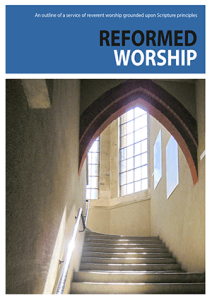
Another publication called Reformed Worship may also be of interest. It is £1. View Sample

Reformed Worship is a vital guide to Reformed Worship Coverworship. Nothing is more sacred and more important than the worship of God. The Bible must have the pre-eminent place in our worship services. But how should a service of public worship feel and sound when the Word of God has central place and reverence for God governs everything? This booklet describes a service of reverent worship grounded upon Scripture principles. It will be helpful for those who conduct public worship as well as those seeking for worship that truly honours God. It will have a hearty reception where there is a sincere desire to know how to worship God in spirit and in truth. It is extracted and updated from an older publication called The Directory of Public Worship. This updated extract is in no way meant to replace the original authoritative document. Instead, it shows its abiding relevance and may encourage many to read the original for themselves.
Thanks to Matthew Vogan for sending this information along!

1640 – The Whole Booke of Psalmes Faithfully Translated into English Metre: Whereunto is Prefixed a Discourse Declaring not Only the Lawfullness, but Also the Necessity of the Heavenly Ordinance of Singing Scripture Psalmes in the Churches of God by Richard Mather

New addition to the “Books Online” page…

1640 The Whole Booke of Psalmes Faithfully Translated into English Metre: Whereunto is Prefixed a Discourse Declaring not Only the Lawfullness, but Also the Necessity of the Heavenly Ordinance of Singing Scripture Psalmes in the Churches of God by Richard Mather

Nearly 800 times in the Psalter we praise our sovereign, covenantal Lord Jesus Christ…

From Brad Johnston’s website

“Over the years, I’ve been mystified as the number one reason people cite for not singing the Psalter is that they don’t get to sing the name of Jesus. I have repeatedly pointed out that they do get to sing Jesus’ divine, covenantal title confessed by all true Christians. The fundamental conviction of the universal Christian faith is that “Jesus is Lord” (Rom. 10:9; 1 Cor. 12:3), and the apostle assures us that those who make such a confession will be saved. Nearly 800 times in the Psalter we praise our sovereign, covenantal Lord Jesus Christ (actually the number is 795 times in 141 different psalms).

That’s why the second section of my recent book 150 Questions about the Psalter is entitled “Christ In The Psalter.” I’ve tried to boil down the Christological insights of my favorite writers into just twenty carefully written question and answers unpacking a Jesus-centered understanding of the Psalter. Here are a few examples (you can find the first twenty questions here)”

Brad Johnston is the Pastor of the Reformed Presbyterian Church of Topeka, KS and the author of the new book “150 Questions about the Psalter”

“…we mourn over their indifference to and disregard of many important and precious truths of God’s word, and the substituting of human inventions for divine institutions in the worship of God.”

“And while we cheerfully admit there are very many of the Lord’s people in all the evangelical churches, and rejoice in all they have done and are doing for the salvation of sinners, and the extension of the kingdom of Jesus Christ, both their Lord and ours, we mourn over their indifference to and disregard of many important and precious truths of God’s word, and the substituting of human inventions for divine institutions in the worship of God. Especially is the praise of God corrupted by human hymns, which in the matter of many of them, as well as in the want of divine appointment for all, are unfit for the worship of God—and also choirs and instrumental music in the place of congregational singing. The whole service of praise seems to be arranged as a mere theatrical performance, and intended to please man, not God. By ignoring scriptural and important doctrines, and by not exercising discipline for popular sins, and arranging the worship of God to gratify the carnal mind, the church has been brought down almost to the level with the world, or changed into a worldly sanctuary. And the popular way for the union of all the churches in one organic body, proceeding, as it does, upon the false assumption that the great principles which have heretofore divided, and still divide, the several churches, are of no value, and unworthy of any regard, is a lamentable evidence of the general decline of the life and power of true religion in these times.”

“A Good Conscience”, The Reformed Presbyterian and Covenanter, Vol 8, January 1870, p21-22

“Considering the Anglo-Scots thought that Christians should continually praise God with these two psalms (107 and 119), the compilers may have been seeking to highlight their didactic function by applying the same tune to both.”

Thanks to Brad Johnston for this helpful quote from Tim Duguid’s  new book on Metrical Psalmody. Brad is the Pastor of the Topeka Reformed Presbyterian (RPCNA) Church in Topeka, KS.

From Timothy Duguid, Metrical Psalms In Print And Practice: English ‘Singing Psalms’ and Scottish ‘Psalm Buiks’, c. 1547-1640, p. 46-47.

“The pairing of Psalms 107 and 119 is classified as a Category 2 conflation. Psalm 107 praises God for his deeds throughout history, and his works for the children of men, especially in the way that he gathered the Israelites from distant lands and preserved them through distress, drought, and slavery. Psalm 119, however, is a series of 22 meditations on the blessings of the Law, acrostically based on the 22 letters in the Hebrew alphabet, with all the letter in each successive meditations beginning with the same letter. Considering the differing content of these two psalms, it is not immediately obvious why they share the same tune. Proverbs 22:6 may be the key, asserting that parents should train their children according to God’s Law, and additionally, teach their children about the Lord’s works throughout history and especially the Passover (Exodus 12). While the Anglo-Scots community understood these as commands from the Old Covenant, the exiles maintained that they still applied to Christians under the New Covenant. In the Order of Baptism, [Knox’s 1560] Forme of Prayers had the pastor recite the following to parents:

Moreouer, ye that be fathers and mothers may take hereby moste singular comfort, to se your children thus receyued in to the bosom of Christes congregation, whereby you are daily admonished that ye nourishe and bring vp the children of God’s fauor and mercye, ouer whom his fatherly prouidence watcheth continually … So oght it to make you diligent, and carefull, to nurture and instruct them in the true knowledge and feare of God … Therefore, it is your duety, withal diligence to puide that your children in tyme conuinient, be instructed in all doctrine necessarie for a true Christian: chiefly that they be taught to rest vpon the iustice of Christ Jesus alone, and to abhorre and flee all superstition, papistrie, and idolatrie.”

… Considering the Anglo-Scots thought that Christians should continually praise God with these two psalms, the compilers may have been seeking to highlight their didactic function by applying the same tune to both.

MY OWN MODERN ENGLISH TRANSLATION of The Forme of Prayers Statement (1560-1561)

Moreover, ye that be fathers and mothers may take [in this baptism] most singular comfort, to see your children thus rescued into the bosom of Christ’s congregation, whereby you are daily admonished that ye nourish and bring up the children in God’s favor and mercy, over whom his fatherly providence watcheth continually … So ought [this baptism] make you diligent and careful to nurture and instruct [this child] in the true knowledge and fear of God … Therefore, it is your duty with all diligence to provide that your children in time convenient, be instructed in all doctrine necessary for a true Christian – chiefly, that they be taught to rest upon the justice of Christ Jesus alone, and to abhor and flee all speculation, false doctrine, and idolatry.”


Exclusive Psalmody Debate, Gordon-Prutow

A cordial informative edifying discussion/debate on the Question: Should we sing psalms exclusively in worship?
Dr. T. David Gordon, Grove City College Prof, takes the negative.
Dr. Dennis Prutow, RPTS Emeritus Prof, takes the affirmative.
Opening Presentations (20 Minutes Each)
Rebuttals (10 Minutes Each)
Debaters Examine Each Other (10 Minutes Each)
Rebuttals/Closings (15 Minutes Each)
Audience Q&A Not Recorded

“The sound of their voices employed in prayer, or in the singing of psalms, probably attracted the notice of the soldiers, and drew them to the spot. “

“The dragoons pursued their way over the hills towards the farm of Cairn, beautifully situated on the slope of the range of mountains that line the sweet vale of the Nith on the south. At this place they came upon two men in a hollow among the green and flowery braes, engaged, it is supposed, in devotional exercises. The sound of their voices employed in prayer, or in the singing of psalms, probably attracted the notice of the soldiers, and drew them to the spot. The names of the individuals were Hair and Corson. The circumstances in which they were found were enough to insure their death, and therefore, according to the custom of the times, and the license of the troopers, they were without ceremony shot on the spot. They lie interred on the south side of the great road between Sanquhar and New Cumnock, where a rude stone pillar points out their resting-place.”

Traditions of the Covenanters by Robert Simpson, p 134.

‘IN MEMORY OF
GEORGE CORSON
AND
JOHN HAIR
WHO WERE SHOT NEAR THIS PLACE
IN 1685, FOR THEIR ADHERENCE TO
DIVINE TRUTH,
AND ATTACHMENTS TO THE
COVENANTED REFORMATION
OF 1638–50.
“They lived unknown,
Till persecution dragged them into fame,
And chased them up to heaven.”
1845’
(Campbell, SW, 181-2; Thomson, Martyr Graves, 339-40.)

Commentaries on the Psalms

Some new updates for the website:

Charles Spurgeon, Treasury of David
David Dickson, Psalms (Vol. 1, Vol. 2, Vol. 3)
Henry Ainsworth, Annotations on the Psalms
John Calvin, Commentary
William Plumer, Psalms
George Horne, Commentary on the Psalms (Vol. 1, Vol. 2, Vol. 3)
Matthew Henry, Commentary
Matthew Poole, Annotations
John Trapp, Commentary
John Gill, Exposition
A.R. Faussett, Commentary
J.A. Alexander, The Psalms
Franz Delitzsch, Commentary
E.W. Hengstenberg, Commentary (Vol. 1, Vol. 2, Vol. 3)
Robert Hawker, Commentary
Thank you Andrew Myers for sending these along!

“obedience is the foundation of true worship”

“If we desire, therefore, that he should approve of the honor which we confer upon him, we ought always to consider what he requires. And, indeed, they who venture to offer to God honors invented by themselves are chargeable with using some sort of force and violence towards him; for obedience is the foundation of true worship. Let us also learn from it with what reverence we ought to abide by the pure and simple word of God; for as soon as we turn aside in the smallest degree, the truth is poisoned by our leaven, so that it is no longer like itself.”

John Calvin, Commentary on John 6:15

…the singing of human compositions in celebrating the praises of God, has its rise in small beginnings…The history of all the corruptions we have mentioned is the same, for the general principle will always hold good: a human invention, once tolerated in the church, will ultimately exclude, or throw into the shade, a divine institution.

As the singing of human compositions in celebrating the praises of God, has its rise in small beginnings: no claim is at first offered on their behalf to the sole possession of this part of God’s worship. In the end, the psalms of scripture are excluded, and, perhaps, even reviled. Singing by choir begins very modestly: the object is merely to improve the music. In the end, the choir claims to be the seat of praise in the house of God. Trustees had no places in the apostolic church. There could have been none at that time. The reformed churches had no such officers. Originally, as there is reason to believe, they were barely tolerated, they are now, sometimes, supported as altogether preferable to deacons; and some, going still farther like the advocates of human psalmody, deny the office of deacon to be at all an important part of the order of the sanctuary. Trustees, man’s invention, they would not dispense with: deacons, Christ s appointment, may be very well neglected. The history of all the corruptions we have mentioned is the same, for the general principle will always hold good: a human invention, once tolerated in the church, will ultimately exclude, or throw into the shade, a divine institution.

James Willson, The Deacon, page 43, 1841

UPDATE on Pageland Reformed Presbyterian Mission (RPCNA): New meeting location

Pageland Reformed Presbyterian Mission is now meeting at:

222 S. Van Lingle Mungo Blvd.
Pageland, SC 29728.

Contact number is 843.517.2088. http://www.pagelandrpc.com.

From an earlier post:

The new church in Pageland has recently called Ian wise to be their Pastor. He accepted and is beginning ministry in October. The church will have an installation service led by Dr. Frank Smith on Saturday October 8th at 10.30am. They hope to have many visitors. All are invited!

From an earlier post:

A new church plant in Pageland, SC will now hold worship services every Lord’s Day morning at 11 am.

From the church’s website:

“Pageland Reformed Presbyterian Church is a ministry of the Reformed Presbyterian Church of North America (RPCNA). We are located in Pageland, South Carolina – 55 minutes from downtown Charlotte, North Carolina and 75 minutes from downtown Columbia, South Carolina.

We meet for worship at 11:00 am in the Cambridge Hall at the Guest Lodge located at:

910 West McGregor Street
Pageland, SC 29728-2014

SEE UPDATED LOCATION ABOVE

Please email pagelandrpc@gmail.com or call 843.622.5853 with any questions.

What we believe:

Our beliefs all stem from a full commitment to the authority of the Bible as the inerrant, infallible Word of God. This means that we believe in the Triune God: Father, Son, and Holy Spirit. We acknowledge our total inability to save ourselves and, in faith, depend on Christ alone as our Savior. We acknowledge Him as Lord in every area of life, and we vow together to advance His Kingdom on earth.

God made man in His image to glorify and enjoy Him. In the public worship of the church, the people of God, redeemed by Christ, glorify and enjoy the triune God, Father, Son, and Holy Spirit, as He reveals Himself in His Word.

Jesus Christ, as our Prophet, Priest and King, has revealed to His people how to worship Him in a pleasing manner. Therefore, “the acceptable way of worshiping the true God is instituted by Himself and so limited by His own revealed will, that He may not be worshiped according to the imaginations and devices of men, or the suggestions of Satan, under any visible representation, or any other way not prescribed in the Holy Scriptures” (Westminster Confession of Faith 21:1 [p.49]). This means true worship is commanded by God only; false worship is anything not commanded. In other words, if God did not direct us in the Bible to do something–we do not do it.”

A news article from November in the Progressive Journal from here quotes the Rev. Frank Smith, “We have maintained the practice of singing the Biblical songs in public worship without musical accompaniment. We’ve maintained those standards through the years. We believe this is the way that God desires to be worshiped. We believe that worship should be worship.”

Las Vegas Reformed Presbyterian Church (RPCNA)

From their website:

Las Vegas Reformed Presbyterian Church is a growing body of worshipers consisting of believers and their children officially taken under care of the Reformed Presbyterian Church of North America (RPCNA) in late 2012.

As part of the RPCNA, we enjoy the supervision and support of the Pacific Coast Presbytery, the regional body of churches to which we belong. We are directly overseen by the session at All Saints Reformed Presbyterian Church in Brea, CA.

At present we are a fellowship, or a church in the making.  We have not called a pastor as of yet,  faithful pastors and teachers of the Reformed Presbyterian Church visit from week to week to dispense the means of grace to us.

COME WORSHIP WITH US!

Location:
8237 Golf Club Ave.
Las Vegas, NV 89145Gate Code:
key key 0053

Service Times:
11:00am – Morning Service
12:30pm – Fellowship Lunch
2:00pm – Afternoon Service

 Contact Information:
Call us 702 606 9286

Recent Posts on Psalmody from the Heidelblog

Sean McDonald has compiled these recent posts from the Heidelblog

On Psalmody:
http://heidelblog.net/2014/09/what-did-the-divines-mean-by-psalms/
http://heidelblog.net/2014/09/psalms-hymns-spiritual-songs-and-instruments-in-the-latin-bibles/
http://heidelblog.net/2014/09/calvin-we-sing-psalms-in-public-worship/

Some new works on Psalmody

There’s a few more items on the Internet Archive on psalmody. Please note, too, that the different editions of Anderson’s “Vindiciae” have some substantial differences between them.

https://archive.org/details/notmody00grie

https://archive.org/details/tamodyi00rals

https://archive.org/details/psalmod00john

https://archive.org/details/ddivin00ande

https://archive.org/details/vindicia00ande

https://archive.org/details/vcantusd00ande

Thanks Sean McDonald!

Do we really need a Psalter Hymnal? – Donald Poundstone

OPC. (1)A recent article was published on the OPC website New Horizons entitled Do We Really Need a Psalter Hymnal? An exert from the beginning of the article sums up the position of Donald Poundstone:

“Our church’s Psalter-Hymnal Committee deserves credit for translating and versifying the book of Psalms and setting individual psalms to singable music. Sadly, this is the best that can be said for a radical and unnecessary project.”

From general contacts and friends, I have been assured that Mr. Poundstone’s comments reflect a minority opinion among other OPC ministers. Thankfully, the poorly presented material in this article does not reflect the overall position in that otherwise fine denomination.

Dr. Dennis Prutow
Dr. Dennis Prutow

Dr. Dennis Prutow of the RPCNA, an Exclusive Psalmody denomination, presents a very good response here.

Peter J. Wallace of Michiana Covenant PCA presents another response here, though not from the perspective of Exclusive Psalmody. Still, Mr. Wallace has very clearly pointed out a few of the mistakes in Mr. Poundstone’s article. Wallace also presents his view here in the same issue of New Horizons.

Eric B. Watkins writes the article entitled Singing the Psalms with the Psalmist in the New Horizons.

Nine Psalter Reviews by Logan West

The following Psalter Reviews have been added to the Articles Online page. Thanks to Logan for these insightful reviews!

1650 Psalter A Review by Logan West
Comprehensive Psalter A Review by Logan West
Psalms for Singing 21st Century A Review by Logan West
Scottish Psalmody A Review by Logan West
Sing Psalms A Review by Logan West
The Psalter of 1912 A Review by Logan West
Book of Psalms for Singing A Review by Logan West
Book of Psalms for Worship A Review by Logan West
Complete Book of Psalms for Singing A Review by Logan West
Collected Reviews A Review by Logan West